



Introduction
The pyrite stone meaning has fascinated people for centuries because of its bright metallic appearance and strong connection with wealth, confidence, and protection. Often called “fool’s gold,” pyrite can look remarkably similar to real gold when viewed from a distance. However, its physical properties and composition make it a distinct mineral with its own fascinating identity.
Beyond its appearance, many people explore pyrite stone meaning because of its symbolic associations. Crystal enthusiasts often connect this stone with abundance, motivation, courage, and personal strength. Collectors appreciate its natural cubic crystals, while students and geology enthusiasts study it to understand how minerals form and behave.
Whether you are interested in mineralogy, history, symbolism, or crystal traditions, learning about pyrite stone meaning provides an interesting way to understand why this mineral remains popular. This guide explores its characteristics, symbolism, traditional uses, benefits, care, and important facts.
What Is Pyrite?
Pyrite is a common iron sulfide mineral with the chemical formula FeS₂. It usually appears in a pale brass-yellow color with a metallic luster. Its resemblance to gold led to the famous nickname “fool’s gold.”
The pyrite stone meaning is partly connected to its golden appearance. Throughout history, people associated its color and shine with wealth and prosperity. However, pyrite is not actually gold. It is harder than gold and commonly forms distinctive cubic or pyritohedral crystals.
Pyrite can develop in many geological environments. It may occur in sedimentary rocks, metamorphic rocks, and hydrothermal deposits. Some specimens form beautiful geometric shapes that make them especially attractive to mineral collectors.
Why Is Pyrite Called Fool’s Gold?
The nickname comes from the fact that inexperienced prospectors sometimes confused pyrite with gold. Both minerals can have a yellowish metallic appearance, particularly when sunlight reflects from their surfaces.
However, they have several important differences. Gold is much softer and more malleable, while pyrite is harder and brittle. Gold also has a higher density and behaves differently when struck or scratched.
Understanding these differences helps explain the geological side of pyrite stone meaning and prevents confusion between the two minerals.
Pyrite Stone Meaning and Symbolism
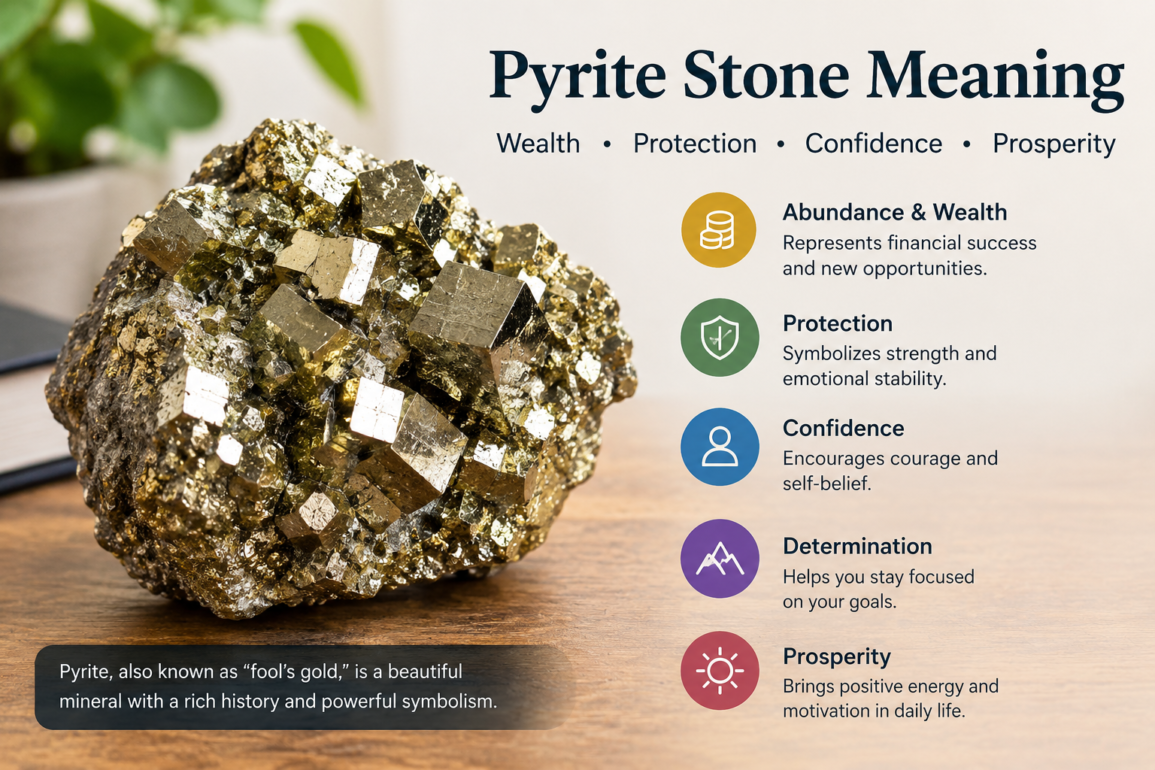
The pyrite stone meaning commonly revolves around abundance, confidence, protection, determination, and prosperity. These associations come largely from crystal traditions rather than established scientific evidence.
Many people consider pyrite a symbolic reminder to remain focused on goals and recognize opportunities. Its bright appearance can represent energy, ambition, and success. For this reason, people sometimes keep pyrite near their workspace or display it in their homes.
Another important part of pyrite stone meaning involves protection. In various modern crystal practices, pyrite is considered a protective stone that symbolizes strength and resilience. People may use it as a personal reminder to establish boundaries and maintain confidence.
It is important to distinguish these traditional interpretations from scientific facts. There is no reliable scientific evidence that pyrite produces supernatural energy or directly changes financial outcomes.
Pyrite Stone Meaning for Wealth and Prosperity
One of the strongest modern associations with pyrite stone meaning is wealth. Its golden appearance naturally encourages comparisons with coins, precious metals, and financial success.
Crystal enthusiasts often use pyrite as a symbolic representation of abundance. Some place specimens on desks, shelves, or in business environments as a reminder of financial goals and productive habits.
The pyrite stone meaning in this context is best understood as symbolic rather than guaranteed. A piece of pyrite cannot create wealth by itself. However, using it as a visual reminder of ambition may encourage someone to remain focused on practical goals.
This makes pyrite particularly interesting as a motivational object. Its appearance can represent the idea of turning determination and effort into meaningful results.
Pyrite Stone Meaning for Protection
Protection is another common interpretation associated with the pyrite stone meaning. In crystal traditions, pyrite is often described as a stone that represents a strong protective barrier.
People who follow these traditions may keep pyrite in rooms, workplaces, or personal collections. The practice is generally symbolic and can serve as a reminder of emotional strength and self-confidence.
From a scientific perspective, pyrite does not have proven protective powers against negative energy or supernatural influences. Still, symbolic objects can have personal meaning, especially when they encourage positive habits and reflection.
Pyrite and Personal Confidence
The pyrite stone meaning also relates to confidence and courage. Its bright appearance and strong geometric forms can symbolize determination and inner strength.
Some people associate pyrite with taking action instead of remaining trapped in doubt. They may use the stone during goal-setting, meditation, journaling, or other reflective activities.
Although there is no scientific proof that pyrite directly increases confidence, the symbolic practice can still have personal value. A meaningful object can remind someone to approach challenges with greater determination.
A Symbol of Motivation
Pyrite is sometimes associated with productivity and motivation because of its connection to ambition and success. Someone working toward a difficult goal might keep a specimen nearby as a visual reminder of their objective.
In this sense, pyrite stone meaning can become personal. One person may associate it with career growth, while another may see it as a symbol of academic achievement, creativity, or perseverance.
Physical Properties of Pyrite
Understanding the physical characteristics of pyrite gives another perspective on pyrite stone meaning. Pyrite belongs to the sulfide mineral group and has a Mohs hardness of approximately 6 to 6.5.
Its metallic luster gives it a shiny appearance, while its brass-yellow color makes it visually distinctive. Pyrite often forms cubes, but it can also occur as pyritohedra, masses, grains, and other forms.
The mineral has a relatively high specific gravity compared with many common rock-forming minerals. When freshly broken or scratched, pyrite can produce a dark greenish-black to brownish-black streak.
These physical properties help geologists and collectors identify pyrite accurately.
Where Is Pyrite Found?
Pyrite occurs in many parts of the world. Significant deposits have been found in countries including Spain, Italy, Peru, China, the United States, and several other regions.
Its formation can occur in environments where sulfur and iron interact under suitable geological conditions. Pyrite may develop within sedimentary deposits, veins, metamorphic rocks, and hydrothermal systems.
The geological history of a specimen can make each piece visually different. Some samples display perfect cubes, while others appear as clusters or irregular masses.
For collectors, these variations add another dimension to pyrite stone meaning, because each specimen can provide insight into natural mineral formation.
Common Uses of Pyrite
Historically, pyrite had practical uses beyond decoration. Because it can produce sparks when struck against certain materials, people used pyrite in early fire-starting methods.
The mineral has also been studied and processed as a source of sulfur and, historically, sulfuric acid production. Today, pyrite remains popular among mineral collectors, educators, jewelry enthusiasts, and people interested in crystal symbolism.
Its attractive appearance makes it suitable for decorative displays. Well-formed pyrite cubes are particularly desirable because of their sharp geometric shapes.
Pyrite in Crystal Practices
Modern crystal communities often give the pyrite stone meaning a spiritual interpretation. It may be associated with abundance, grounding, confidence, protection, and determination.
Some practitioners use pyrite during meditation or place it around their living and working spaces. Others simply appreciate it as a symbolic object.
These practices should be viewed as cultural or personal beliefs rather than medical or scientific treatments. Pyrite should not replace professional advice for health, financial, or psychological concerns.
How to Identify Genuine Pyrite
Identifying pyrite can be easier when you know its physical characteristics. Genuine pyrite generally has a brass-yellow metallic color and is noticeably harder than gold.
Its crystal shape can also provide clues. Cubic crystals with well-defined faces are particularly characteristic. However, not every specimen has a perfect cube.
Weight can provide another useful distinction. Pyrite is relatively dense, but gold is considerably denser. A proper mineral identification test can provide greater certainty when appearance alone is insufficient.
If you purchase a valuable specimen, consider obtaining information about its locality and mineral composition from a reputable mineral dealer.
How to Care for Pyrite
Proper storage is important because pyrite can react with moisture and oxygen over time. Some specimens may develop surface deterioration, particularly when stored in unsuitable environmental conditions.
Keep pyrite in a dry location and avoid prolonged exposure to humidity. A protective display case can help reduce environmental exposure.
If cleaning is necessary, use gentle methods and avoid harsh chemicals unless you understand their effects on the mineral. Delicate crystal formations can break if handled roughly.
Good care helps preserve both the physical beauty and the symbolic value associated with pyrite stone meaning.
Is Pyrite Safe to Handle?
Generally, handling an intact pyrite specimen is not considered a major concern. However, pyrite contains sulfur and iron, and weathered specimens can produce acidic products during oxidation.
Avoid intentionally grinding, crushing, or inhaling mineral dust. Wash your hands after handling mineral specimens, especially before eating.
Pyrite should also be kept away from unnecessary moisture because oxidation can damage specimens and create unpleasant surface changes.
Pyrite Stone Meaning in Modern Life
Today, the pyrite stone meaning continues to evolve. Some people appreciate pyrite primarily as a geological specimen, while others value its traditional symbolism.
For collectors, it represents an impressive example of natural crystal growth. For crystal enthusiasts, it can symbolize prosperity and confidence. For educators, it offers an accessible way to discuss mineral properties and geological processes.
This combination of science, history, appearance, and symbolism explains why pyrite remains a popular mineral.
Frequently Asked Questions
What does pyrite symbolize?
The pyrite stone meaning commonly includes abundance, confidence, protection, determination, and prosperity. These interpretations come from cultural and crystal traditions rather than scientific evidence.
Is pyrite real gold?
No. Pyrite is iron sulfide, while gold is a separate chemical element. Their similar appearance explains why pyrite is commonly called fool’s gold.
Can pyrite attract wealth?
Many crystal traditions associate pyrite stone meaning with wealth and abundance. However, there is no scientific evidence that pyrite can directly attract money or change financial circumstances.
Why is pyrite popular?
Pyrite is popular because of its bright metallic appearance, distinctive crystal shapes, geological importance, historical uses, and symbolic associations.
Can pyrite get damaged?
Yes. Pyrite can deteriorate when exposed to moisture and oxygen for extended periods. Keeping specimens dry and storing them properly can help preserve their appearance.
Conclusion
The pyrite stone meaning combines geological facts with centuries of fascination surrounding its golden appearance. Known as fool’s gold, pyrite is an iron sulfide mineral that can form striking cubic and geometric crystals. Its physical properties make it scientifically interesting, while its symbolism has made it popular among collectors and crystal enthusiasts.
Modern interpretations of pyrite stone meaning often focus on prosperity, confidence, protection, motivation, and determination. These meanings are best understood as cultural and personal symbolism rather than scientifically proven effects.
Whether you collect minerals, study geology, decorate your space, or simply appreciate natural crystals, pyrite offers something fascinating. Its distinctive appearance and rich history make it much more than a stone that resembles gold.