




Understanding ritual purification is an important part of Islamic practice. For Muslim women, knowing when and how to perform ghusl for women can make daily worship easier and more confident. Ghusl is a complete ritual bath performed to remove major ritual impurity and prepare a person for acts of worship that require purification.
Although the basic purpose remains the same, some details can differ between Islamic schools of thought. Women may also have specific questions about ghusl after menstruation, postpartum bleeding, marital relations, or other circumstances. Learning the essential requirements helps you perform the bath correctly without unnecessary difficulty.
This guide explains the meaning, circumstances, method, requirements, and common questions surrounding ritual purification for women in clear and practical language.
What Is Ghusl in Islam?
Ghusl is a complete ritual washing of the body. It differs from ordinary bathing because it is performed with the intention of achieving ritual purification. While normal bathing focuses on physical cleanliness, ghusl has both physical and religious significance.
The general principle of ghusl for women is to ensure that water reaches the entire body while observing the requirements established by Islamic teachings. A person should approach the process with the intention of purification and complete the washing properly.
Ghusl is particularly important because certain forms of major ritual impurity prevent a Muslim from performing some acts of worship until purification has taken place.
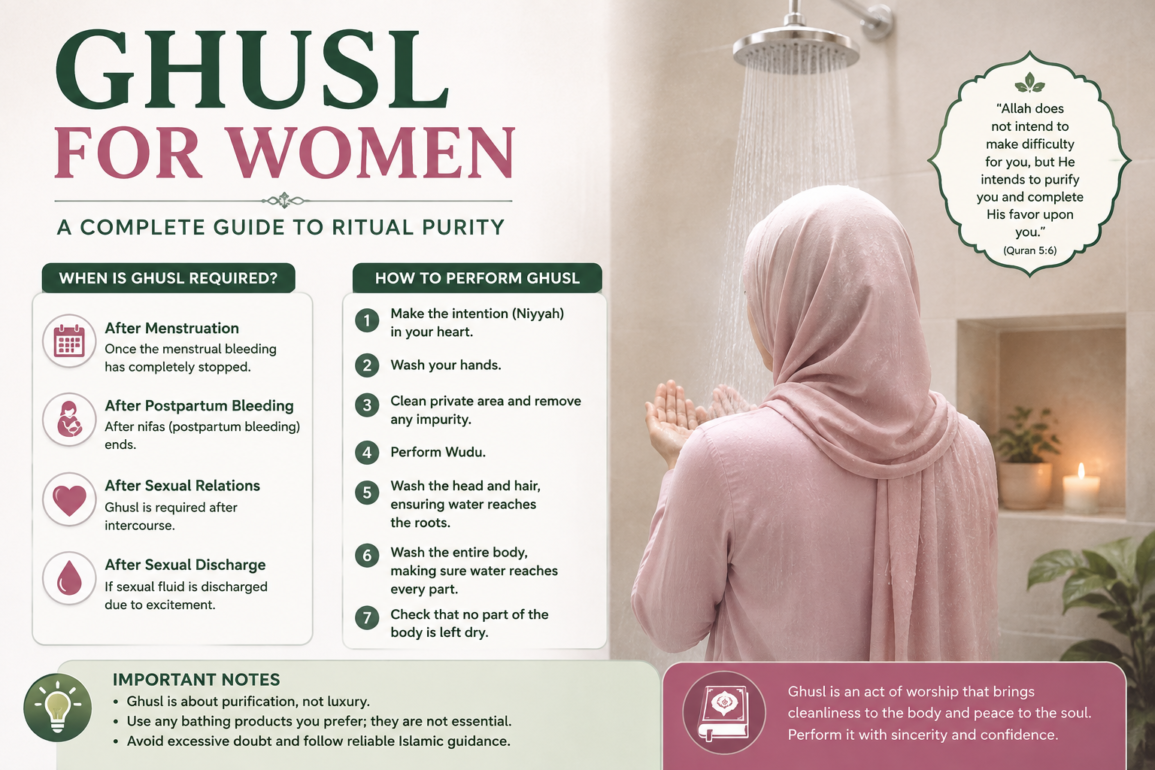
When Is Ghusl Required for Women?
There are several circumstances in which a woman may need to perform ghusl. Understanding these situations can prevent confusion and help maintain regular worship.
After Menstruation
When menstrual bleeding ends, a Muslim woman performs ghusl before returning to certain acts of worship that require ritual purity. The woman should make sure that her period has completely ended before performing the purification bath.
After Postpartum Bleeding
Postpartum bleeding, known as nifas, also requires purification when it ends. Once the bleeding has stopped according to the applicable religious guidelines, the woman performs ghusl before resuming worship that requires purification.
After Sexual Relations
Ghusl becomes necessary after sexual intercourse, even when ejaculation does not occur. This ghusl for women rule applies to both spouses and is part of the broader Islamic guidelines concerning major ritual impurity.
Following Sexual Discharge
Ghusl can also become necessary following the discharge of sexual fluid associated with sexual pleasure. Because specific circumstances can vary, anyone uncertain about a particular situation should consult a trusted qualified Islamic scholar.
Intention Before Ghusl
Intention, or niyyah, is an important part of Islamic worship. Before beginning ghusl for women, a woman should intend in her heart that she is performing the bath to remove major ritual impurity and become purified for worship.
The intention does not necessarily have to be spoken aloud. It is primarily an intention of the heart. A simple inward decision to perform the required purification is sufficient according to many Islamic scholars.
The intention also helps distinguish ritual purification from an ordinary shower or bath.
How to Perform Ghusl for Women
The detailed Sunnah method includes several steps. While minor differences exist between schools of jurisprudence, the following method provides a useful general framework.
1. Make the Intention
Begin by making the intention in your heart to perform ghusl for purification. You do not need to make the intention loudly.
2. Wash the Hands
Wash your hands thoroughly. This ghusl for women follows the general practice of beginning purification with clean hands.
3. Clean the Private Area
Wash away any physical impurity from the private area and other parts of the body that may require cleaning. Physical impurities should be removed before completing the purification process.
4. Perform Wudu
Perform wudu as you would before prayer. Depending on the circumstances and the method followed, some people perform the feet at the end of ghusl if the bathing area collects water.
5. Wash the Head and Hair
Pour water over the head and make sure the water reaches the roots of the hair and scalp. This ghusl for women is an important part of ghusl for women.
A woman does not generally need to undo tightly braided hair if water can adequately reach the roots, although details can differ according to the situation and school of jurisprudence.
6. Wash the Entire Body
Pour water over the entire body. Make sure water reaches areas that are sometimes overlooked, including the underarms, navel, behind the ears, between the fingers and toes, and other folds of skin.
The objective is to ensure that no part of the body that must be washed remains dry.
7. Check That Water Has Reached Everywhere
Before finishing, make a quick mental check that the whole body has been washed. This ghusl for women helps avoid unnecessary doubts later.
Ghusl After Menstruation
Ghusl following menstruation has special importance. A woman should first establish that her menstrual bleeding has ended. Signs of purity can differ among women, so familiarity with one’s normal menstrual pattern can be helpful.
After purification, she performs ghusl according to Islamic guidance. The process generally involves intention, removal of physical impurity, washing the body, and ensuring that water reaches the hair and skin.
Women should not become overwhelmed by doubts during purification. Islam does not require a person to repeatedly wash the same area because of unsupported uncertainty.
Does Ghusl Require Shampoo or Soap?
No. Soap and shampoo are not generally what make ghusl valid. The essential concern is ritual purification and ensuring that water reaches the required parts of the body.
A woman may use soap, shampoo, conditioner, or other normal bathing products if she wishes. These products can help with physical cleanliness, but they are not themselves the basis of ritual purification.
This ghusl for women distinction can make ghusl for women much simpler. You can combine ritual purification with a normal shower as long as the requirements of ghusl are fulfilled.
What About Nail Polish and Waterproof Products?
Anything that forms a barrier preventing water from reaching the surface that must be washed should be removed before ghusl. Traditional nail polish is commonly considered an example because it creates a layer over the nails.
Similarly, waterproof cosmetics or substances that prevent water from reaching the skin may need to be removed.
The key principle is simple: water must reach the areas that Islamic law requires to be washed.
Common Mistakes During Ghusl
Many women worry about whether they have performed ghusl correctly. In most cases, the process is straightforward.
One common mistake is focusing excessively on repeating the washing. Ghusl does not require endless repetition. Another mistake is forgetting areas such as the scalp, navel, underarms, or between the toes.
Some people also believe that expensive bathing products or a long shower are necessary. They are not. Ghusl is fundamentally about purification, not luxury or the length of the shower.
Another issue is confusing ordinary cleanliness with ritual purity. A person can be physically clean but still require ghusl for certain forms of worship.
Does Ghusl Replace Wudu?
In many circumstances, a properly performed ghusl can include purification that makes separate wudu unnecessary, provided nothing occurs during or after ghusl that invalidates wudu.
However, details can differ according to the circumstances and the school of Islamic jurisprudence being followed. For this ghusl for women reason, someone who wants to follow a particular madhhab should use its established guidance.
The safest approach is to understand the basic principles and follow a reliable scholarly source consistently.
Can Women Perform Ghusl in a Shower?
Yes. A shower can be used for ghusl. There is no requirement to use a particular type of container or bathing arrangement.
A woman can enter the shower, make her intention, remove physical impurity, and ensure that water reaches the entire body according to the requirements of ghusl.
This ghusl for women makes modern bathing facilities completely suitable for ghusl for women, provided the necessary purification requirements are fulfilled.
Practical Tips for Easier Ghusl
Learning a simple routine can make purification less stressful. Keep the process organized rather than repeatedly questioning whether every step was completed.
Use a normal shower routine and incorporate the religious requirements into it. Pay particular attention to the scalp, skin folds, and areas where water might not naturally reach.
If you frequently experience uncertainty about purification, avoid turning every small doubt into a reason to repeat the entire bath. Islamic worship is not intended to create unnecessary hardship.
For questions involving menstruation, postpartum bleeding, or unusual circumstances, consult a qualified scholar who understands the relevant school of Islamic jurisprudence.
Frequently Asked Questions
How long does ghusl take for women?
There is no fixed required duration. Ghusl can be completed relatively quickly when the necessary steps are fulfilled. The purpose is purification, not spending a specific amount of time in the bathroom.
Does a woman have to wash her hair completely?
Water should reach the hair roots and scalp as required. Whether braided hair must be undone can depend on the circumstances and jurisprudential school. If water can reach the roots without undoing the braid, many scholars do not require it ghusl for women to be undone.
Can soap be used during ghusl?
Yes. Soap and shampoo can be used for ordinary cleanliness. They are not essential to the validity of ghusl, however.
Is intention spoken aloud?
The intention is primarily an act of the heart. There is generally no requirement to announce it ghusl for women verbally.
What should a woman do if she is unsure whether ghusl was valid?
She should avoid excessive doubt and review the basic requirements calmly. If the uncertainty concerns a specific religious ruling, asking a qualified and trusted Islamic scholar can provide clarity.
Conclusion
Learning ghusl for women does not need to be complicated. The central purpose is to achieve ritual purification while ensuring that the required parts of the body are properly washed. Intention, removing physical impurity, washing the body, and making sure water reaches the necessary areas form the foundation of the process.
Women may encounter different circumstances, particularly after menstruation, postpartum bleeding, or marital relations. Because some detailed rulings vary between Islamic schools, it ghusl for women is helpful to follow a reliable scholarly source when a specific situation requires clarification. With a clear understanding of the basic principles, ghusl can become a simple, confident, and meaningful part of everyday religious practice.